
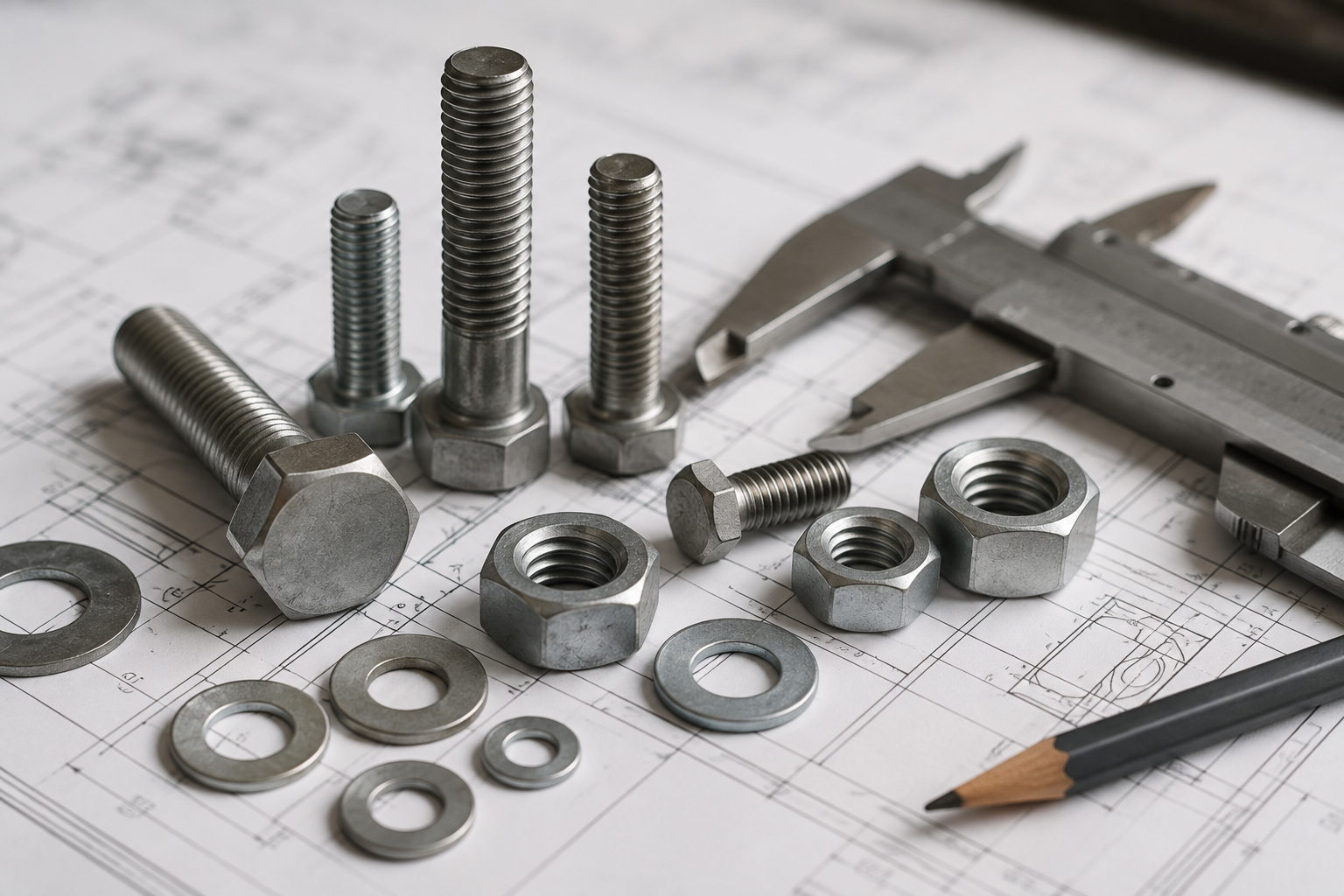
Fasteners are governed by different standards in different parts of the world, and one of the most common friction points in international sourcing is matching a specification across systems. A buyer working to ASTM may receive a drawing referencing DIN; an Indian project may specify IS while the client expects BS. Understanding how these standards relate — and where they don't map cleanly — saves time, avoids costly mistakes, and makes cross-border sourcing far smoother. This guide gives a practical overview for engineers and procurement teams. It is a starting reference, not a substitute for verifying the exact grade and dimension against the governing standard for your application.
The four systems you'll encounter most - DIN (Deutsches Institut für Normung) is the German standards system widely used across Europe and, historically, the default reference for much of the world's fastener trade; many DIN standards have been superseded by ISO equivalents but remain in common commercial use. ASTM (American Society for Testing and Materials) is the dominant system in North America, especially for structural and high-strength applications. BS (British Standards) is used in the UK and many Commonwealth markets, increasingly aligned with European EN/ISO standards. IS (Indian Standards, by the Bureau of Indian Standards) is the governing system for fasteners manufactured and used within India, often harmonised with ISO.
Common dimensional cross-references - For everyday fasteners, several DIN standards have widely recognised equivalents. Hex head bolts DIN 931 / DIN 933 correspond broadly to ISO 4014 / ISO 4017. Hex nuts DIN 934 correspond to ISO 4032. Washers DIN 125 correspond to ISO 7089. Socket head cap screws DIN 912 correspond to ISO 4762. Because many DIN standards now carry ISO equivalents, and BS and IS are both increasingly ISO-aligned, ISO often acts as the common language that bridges the four systems. When a drawing references DIN, converting to the ISO equivalent is frequently the cleanest way to communicate the same part to a supplier working in another standard.
Property classes and grades - Dimensional standards define shape and size; a separate set defines strength. For steel bolts, the metric property class system (4.6, 8.8, 10.9, 12.9) indicates tensile strength and yield. In the ASTM world, structural bolts are specified by grade designations such as A307, A325, and A490. Matching these correctly matters enormously — a dimensional match with the wrong strength class is a failure waiting to happen. Always confirm the property class or grade separately from the dimensional standard.
Stainless steel designations - For corrosion-resistant fasteners, the common grades are 304 (A2) and 316 (A4). The A2/A4 designations appear in ISO 3506, while 304/316 follow the AISI system more familiar in North America and India. They refer to the same materials — a frequent source of confusion when a European drawing and an Indian manufacturer describe the same stainless part in different terms.
Why this matters for sourcing - When you source across borders, mismatched standards cause three problems: delays while specifications are clarified, quoting errors, and — worst of all — wrong parts arriving on site. The way to avoid all three is to give your supplier the fullest possible specification: the dimensional standard, the property class or grade, the material, and the coating. A capable manufacturer will confirm the cross-reference back to you before production — and if they can quote directly from your drawing, most of this ambiguity disappears entirely.
A note on verification - Standards are periodically revised, and equivalences are rarely perfect — tolerances, thread details, and head dimensions can differ slightly between systems. Treat any cross-reference as a guide, and confirm the exact governing standard and revision for safety-critical or structural applications.
Canco Fasteners manufactures to DIN, ASTM, BS and IS standards across mild steel, stainless, brass and non-metals. If you have a drawing or specification in any standard, send it to us and our engineering team will confirm the exact match and respond within 48 hours.